Unions in the 1920s persisted in their fight for better hours, wages, and benefits; local legislation and technological advancements created a safer workplace. The United Packinghouse Workers of America led this charge in opposition of the beef trusts, but lost relevancy when slaughterhouses moved to rural areas.
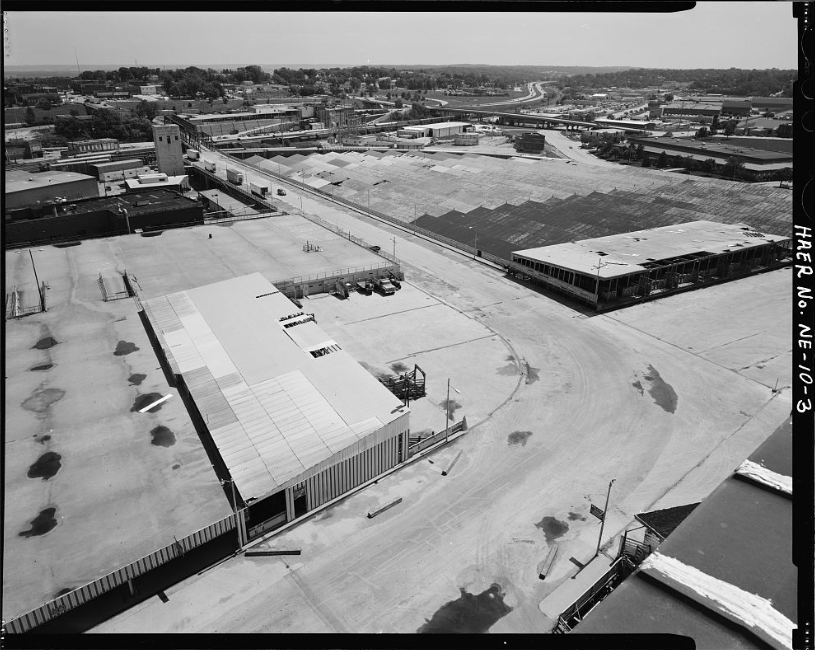
[Stock Yards Autopark, motortruck division.]
|
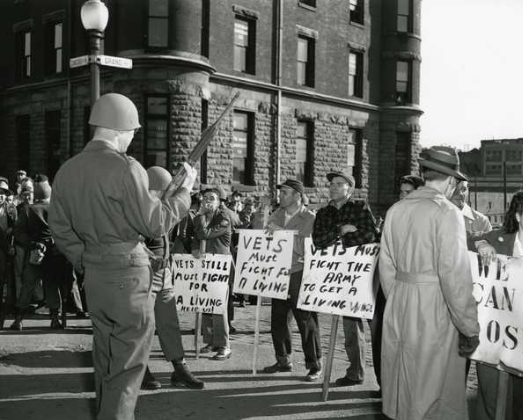
[National guard and meatpacking strikers stand off at the intersection of Grand Avenue and Concord Street, South St. Paul, May 1948.]
|
Due to evolving transportation, infrastructure, and technology, Chicago’s stockyards closed in 1945. Meatpackers built plants in locations closer to cattle ranches, with the added advantage that rural areas were less unionized. Midwestern states’ reliance on the meatpacking industry promise few safety reforms; as such, meatpacking is still considered the most dangerous factory job in America.
Despite the passage of the 1970 Occupational Safety and Health Act which promised a universally safe workplace, the safety and politico-economic environment of meatpacking remains largely the same.

[Warren K. Leffler. Occupational safety & health act news conf. 1971.]
|
[Can’t Take No More. Occupational Safety and Health Administration, Durrin Films, Inc., 1980.] |
|
Modern writers have followed Sinclair’s efforts to inspire change, but with little impact. Investigative pieces like Ted Genoways’ The Chain explores today’s tragic treatment of meatpacking laborers.
|
“Tragically, ... if somebody works at a plant ... for five years, there's a 50/50 chance they'll be injured.”[Christopher Leonard. The Chain Book Talk. 2014.] |
Then“This process of 'speeding up' has been regularly and systematically carried out in every department, until an employe [sic] informed the writer a short time ago that he was now doing precisely twice as much as he was doing fifteen years ago with exactly the same tools. That marvelous speed ... is simply inhumanly hard work.”[A. M. Simons. "Packingtown", The Pocket Library of Socialism. 1899.] |
Now“There is no cap on line speed. It's really the USDA inspectors who set the pace of the work. So there's a kind of gap in the regulation that exists where the meatpacking workers are concerned. Right now there is a lawsuit pending ... suing both OSHA and the USDA for not ... addressing the problem.”[Ted Genoways. The Chain Book Talk. 2014.] |
Sinclair’s intention was to better meatpacking labor conditions, making it truly tragic how little has changed for slaughterhouse laborers.
